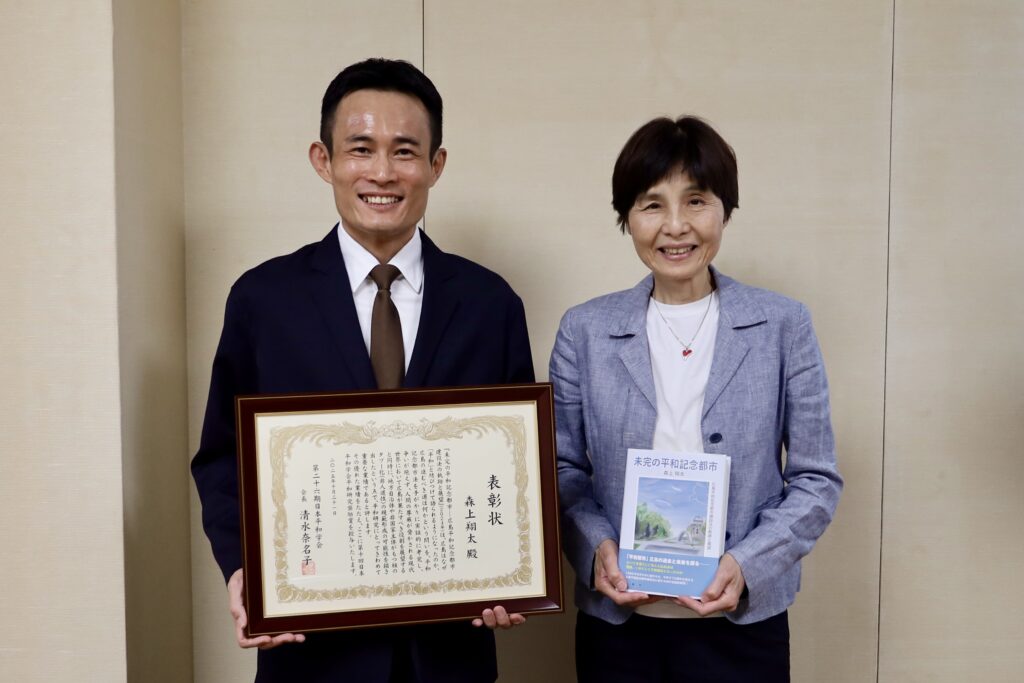
森上講師の著書『未完の平和記念都市――広島平和記念都市建設法の軌跡と展望』(論創社 2024年)が、第10回日本平和学会平和研究奨励賞を受賞し、2026年5月16日、青山学院大学において授賞式が行われました。
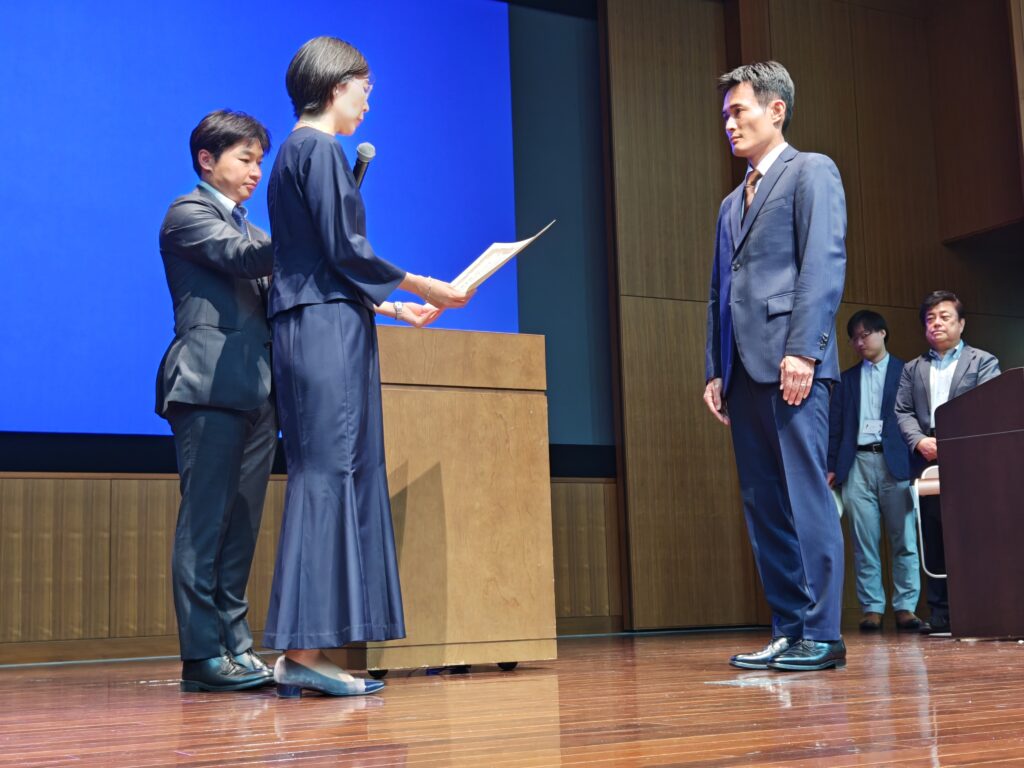
また、前田香織学長からも祝意の言葉が贈られました。
参考:「森上講師が第10回日本平和学会平和研究奨励賞を受賞」
https://www.peace.hiroshima-cu.ac.jp/others/the-10th-peace-research-encouragement-award/
*この記事は『Hiroshima Research News』70号に掲載予定のものです。
ニューズレター過去号はこちらから。
第10回日本平和学会平和研究奨励賞を受賞して
この度、拙著『未完の平和記念都市──広島平和記念都市建設法の軌跡と展望』(論創社、2024年)が、第10回日本平和学会平和研究奨励賞を受賞しました。本書は、2024年に広島市立大学大学院平和学研究科に提出した博士論文を書籍化したものです。指導教官を務めてくださった永井均教授を始め、御指導・御支援いただいた先生方や関係者の皆様に、心より感謝申し上げます。
「広島平和記念都市建設法」という名前を聞いて、ピンとくる方はどれほどいらっしゃるでしょうか。1949年8月6日、原爆投下から4年後に公布・施行されたこの法律は、広島を世界で唯一、法律に根拠をもつ「平和都市」として位置付けた画期的なものです。しかし今日、その存在は、市民にも行政実務においても、ほとんど意識されていません。
本書では、この法律の制定過程をたどるとともに、条文の解釈と運用、世界各地の「平和都市」との比較研究などを試みました。とりわけ着目したのが、第6条が定める広島市長の責務、すなわち、平和記念都市の完成に向けた「不断の活動」です。「平和記念都市」とは、市長と市民との対話の中で絶えず更新し続けるべきものである——この理念は、今の時代にこそ響くように思います。
今後は、二つの軸で研究を進めてまいります。一つは、歴代市長による「不断の活動」の軌跡を振り返り、広島の復興の歴史を体系的に整理するというローカルな問いです。もう一つは、世界に広がる「平和都市」ネットワークが核軍縮に果たす役割を実証的に解明するというグローバルな問いです。これは、本書が描き出し、受賞理由でも評価された、「地方自治体や非国家主体がもつ核のタブー化(非人道性)の規範形成の可能性」をさらに掘り下げるものです。この二つの軸を通じて、被爆100年に向けた「まち」の発展と記憶の継承に貢献してまいります。本書のタイトルと同じく、私の研究も、まだまだ未完です。
Lecturer Moriue attended the award ceremony for the 10th Peace Research Encouragement Award
Lecturer Moriue’s book, Mikan no Heiwa Kinen Toshi: Hiroshima Heiwa Kinen Toshi Kensetsu Hou no Kiseki to Tembo [The Incomplete Peace Memorial City: The History and Prospects of the Hiroshima Peace Memorial City Construction Law] (Tokyo: Ronso-sha, 2024), received the 10th Peace Studies Encouragement Award of the Peace Studies Association of Japan. The award ceremony was held on May 16, 2026, at Aoyama Gakuin University, Tokyo.
President Kaori Maeda also offered congratulatory remarks.
Link: Lecturer Moriue received the 10th Peace Research Encouragement Award of the Peace Studies Association of Japan.
https://www.peace.hiroshima-cu.ac.jp/others/the-10th-peace-research-encouragement-award/
This article is forthcoming in the 70th issue of Hiroshima Research News.
Click here to see past issues of the Newsletter.
Receiving the 10th Peace Research Encouragement Award of the Peace Studies Association of Japan
I am honored to announce that my book Mikan no Heiwa Kinen Toshi: Hiroshima Heiwa Kinen Toshi Kensetsu Hou no Kiseki to Tembo [The Incomplete Peace Memorial City: The History and Prospects of the Hiroshima Peace Memorial City Construction Law] (Tokyo: Ronso-sha, 2024) has received the 10th Peace Research Encouragement Award of the Peace Studies Association of Japan. This book is a revised and published version of my doctoral dissertation submitted to the Graduate School of Peace Studies at Hiroshima City University in 2024. I would like to express my sincere gratitude to my supervisor, Professor Hitoshi Nagai, as well as to all the faculty members and those involved who have guided and supported me throughout this research.
How many people, upon hearing the name "Hiroshima Peace Memorial City Construction Law," would know what it refers to? Promulgated and enacted on August 6, 1949 — four years after the atomic bombing — this landmark law established Hiroshima as the world's only city designated as a "city of peace" by national legislation. Yet today, its existence is hardly recognized, either by the citizens of Hiroshima or in the day-to-day practice of local government.
In this book, I trace the process by which the law was drafted and enacted, examine the interpretation and application of its provisions, and conduct a comparative study of "cities of peace" around the world. Of particular interest is Article 6, which sets out the responsibility of the Mayor of Hiroshima — namely, the obligation to engage in "continuous activity" toward the realization of the Peace Memorial City. The idea that the "Peace Memorial City" is not a fixed destination but something that must be continually renewed through dialogue between the mayor and citizens resonates deeply in our present times.
Going forward, I intend to pursue my research along two axes. The first is a local inquiry: to trace the history of "continuous activity" undertaken by successive mayors and to systematically document the history of Hiroshima's postwar recovery. The second is a global inquiry: to empirically examine the role that the growing worldwide network of "cities of peace" can play in shaping norms around nuclear disarmament. This builds on and deepens the argument advanced in this book — and recognized in the selection committee's comments — regarding "the potential of local governments and non-state actors to shape norms around the taboo on nuclear weapons and their inhumanity." Through these two lines of inquiry, I hope to contribute to the development of the city and the preservation of its memory as we look toward the centenary of the atomic bombing. Like the title of this book, my research, too, remains very much unfinished.