
The Hiroshima Peace Institute (HPI) of Hiroshima City University will hold the HPI Research Forum as follows:
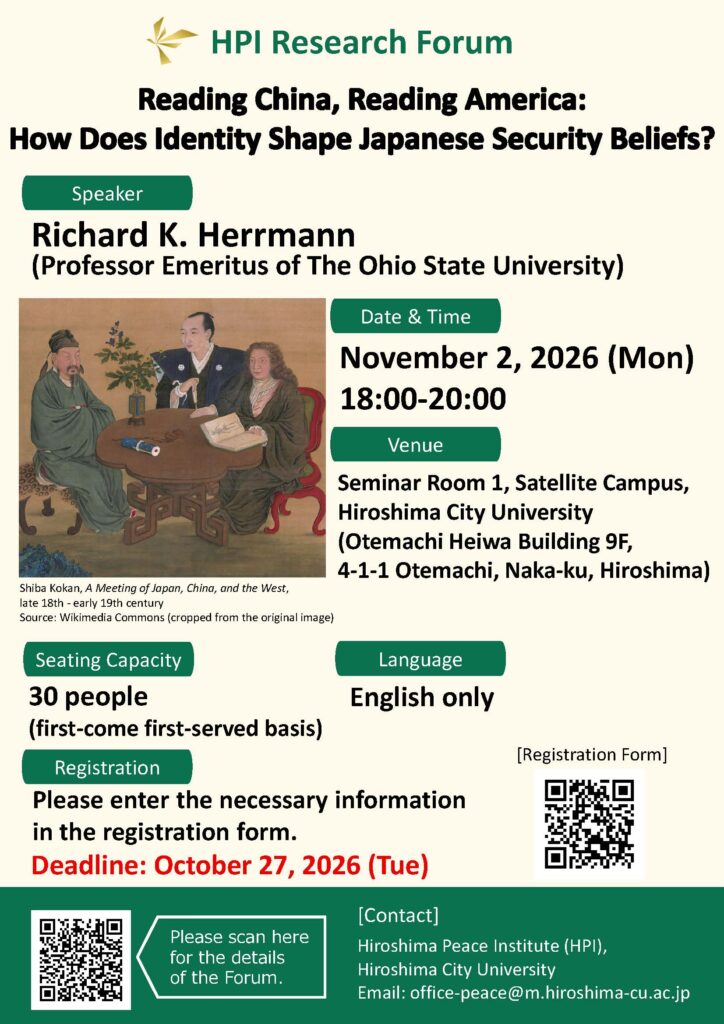
Please click here for the registration details.
1. Speaker
Richard K. Herrmann (Professor Emeritus of The Ohio State University)
2. Topic
“Reading China, Reading America: How Does Identity Shape Japanese Security Beliefs?”
3. Date and Time
November 2, 2026 (Monday) 18:00-20:00
4. Venue
Seminar Room 1, Satellite Campus, Hiroshima City University
(Otemachi Heiwa Building 9F, 4-1-1 Otemachi, Naka-ku, Hiroshima)
5. Seating Capacity
30 people (first-come first-served basis)
6. Language
English only
7. Abstract of the Forum
Herrmann opens with a provocative comparison: Gorbachev's retrenchment is often read in the West as forced by Soviet weakness, Trump's as a president's choice; elsewhere, the readings often reverse. That same interpretive problem--whether structure compels behavior or leaders choose it--is now playing out over Japan. Japan's recent trajectory fits realist expectations closely: a doubled defense budget, a new Joint Operations Command, counterstrike capabilities, deepened Quad cooperation, reduced dependence on China. Yet Japanese opinion remains sharply divided: on collective self-defense if China attacks Taiwan, on continued investment in China despite de-risking rhetoric, on revising Article 9, and on trust in American extended deterrence. If structure alone drove outcomes, these disputes should be settling; they do not seem to be. Drawing on research on motivated reasoning and the affect heuristic, Herrmann argues that judgments about a rival's intentions and an ally's reliability are often shaped by identity attachments rather than evidence. He proposes a new study measuring three potential identities among Japanese respondents--national attachment, attachment to a pacifist rules-based order, and a realist self-help orientation. Building on survey experiments used in other countries, he proposes to test whether transnational attachment produces genuine normative consistency or identity-motivated double standards in how Japanese citizens judge China, the United States, and their own security choices.
8. Profile of the Speaker
Richard K. Herrmann is Arts and Sciences Distinguished Professor Emeritus of Political Science at The Ohio State University, where he chaired the Political Science Department from 2011 to 2019 and directed the Mershon Center for International Security Studies from 2002 to 2011. Earlier in his career, Dr. Herrmann served on Secretary of State James Baker's Policy Planning Staff at the State Department. He has written extensively on American foreign policy, international security, and Middle East politics, with research appearing in the American Political Science Review, International Organization, World Politics, and International Security, among other leading journals. Last year he published “U.S. strategy in the Middle East as a 21st century Cold War gains steam.” In Lynch, Marc, editor. Debating American Primacy in the Middle East. POMEPS Studies 54, 2025. This year, he completed a book manuscript entitled Making Hard Questions Easy: Identity, Motivated Reasoning, and Political Judgment in a Divided World.
9. Registration
(1) Fill out the application form (external link) with the necessary information.
(2) Within 3 days of your application, the Hiroshima Peace Institute (HPI) will send you an application confirmation email.
Application Deadline: October 27, 2026 (Tuesday)
*If you do not receive an email from the HPI within 3 days, please register again. The email address that you provided may have been inaccurate.
* If you fail to register by the application deadline, please contact the HPI Office.
10. Notes
・This forum will be conducted only in English.
・This forum may be cancelled at short notice due to a lecturer's circumstances or other unexpected reasons. Thank you for your understanding in advance regarding this possibility.
Contact
Hiroshima Peace Institute (HPI), Hiroshima City University
Email:office-peace&m.hiroshima-cu.ac.jp
*When sending, please replace "&" with "@".